Sixty years on, football\'s most debated goal still has no definitive answer. The moment Geoff Hurst\'s shot crashed off the Wembley crossbar and down toward the goal line on 30 July 1966 created a controversy that has outlasted careers, technologies, and entire generations of referees. For officials, it remains the ultimate case study in decision-making under pressure.
What Actually Happened
With England and West Germany level at 2–2 in extra time, Hurst struck a fierce shot that rebounded downward off the underside of the crossbar. Swiss referee Gottfried Dienst was unsighted and turned immediately to his Soviet linesman, Tofiq Bahramov, who had sprinted toward the goal line. Bahramov signalled goal. Dienst awarded it. England went on to win 4–2.
Under the Laws of the Game as written in 1966 — and essentially as they remain today under IFAB Law 10 — a goal is scored when the whole of the ball passes over the whole of the goal line, between the goalposts and under the crossbar. That single word, whole, is everything.
What the Science Says
Every serious scientific analysis conducted since 1966 has reached broadly the same conclusion: the ball did not fully cross the line. Oxford University physicist Alan Radford and subsequent digital studies using frame-by-frame film reconstruction consistently place the maximum encroachment of the ball at around 2–6 centimetres short of fully crossing. Had goal-line technology — mandated by IFAB from 2012 and now standard in elite competitions via systems such as Hawk-Eye — been available, the goal almost certainly would not have stood.
The Linesman\'s Perspective
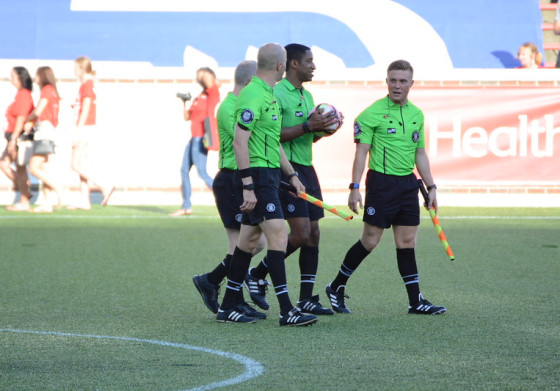
Bahramov\'s exact sightline has been questioned for decades. From his reported position near the corner flag, the angle made a definitive read of the goal line geometrically difficult. This is not a criticism of his integrity; it is a reminder that human perception at high speed, from an imperfect angle, has natural limits. Modern assistant referee positioning protocols, updated progressively through UEFA and FIFA referee instructor programmes, are in part designed to address precisely these situations — requiring assistants to hold the second-to-last defender line rather than chase play speculatively.
What It Changed for Officiating
- It accelerated long-term pressure for technological assistance in goal decisions.
- It demonstrated the importance of clear assistant referee positioning and communication protocols.
- It remains a core teaching case in referee education programmes at both national association and confederation level.
The Takeaway
The 1966 final goal is not a story of a bad referee — Dienst followed correct procedure by consulting the official best placed to judge. It is a story of the hard limits of unaided human judgment and why the Laws of the Game must evolve alongside technology. As goal-line systems, VAR, and semi-automated tools continue to be refined across competitions tracked here at WorldReferee.com, Hurst\'s ghost goal serves as the most powerful reminder of why getting the decision right matters more than any tradition of human-only officiating. Sixty years of argument is proof enough.